
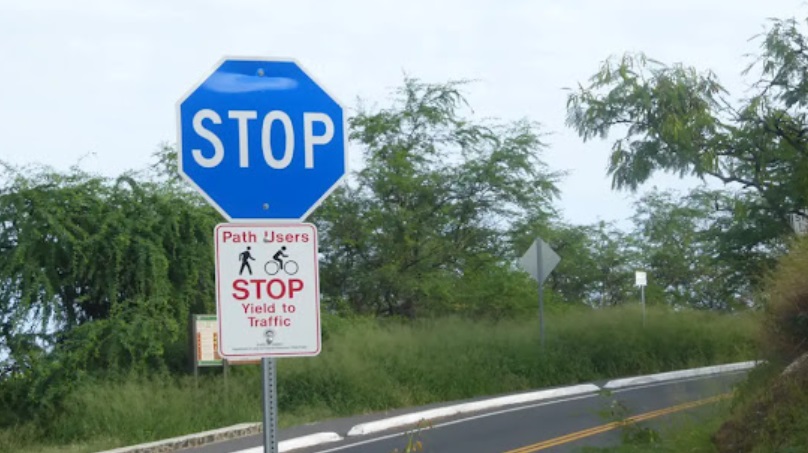
You’re driving through a quiet neighborhood, sunlight flickering through the trees, when something feels… off. Ahead of you stands a stop sign—but it’s blue. Not red. Not the bold, unmistakable red you’ve seen your whole life. Blue.
For a split second, your brain scrambles. Is this a joke? A mistake? Did someone swap it overnight? Your foot hesitates over the brake pedal as curiosity and caution collide.
Take a breath. You’re not in an alternate universe. You’ve simply encountered one of the most misunderstood road features out there: the blue stop sign.
The Short Answer: Yes, You Should Still Stop
Even though it’s blue, a blue stop sign almost always means the same thing as a red one: come to a complete stop, check for traffic or pedestrians, and proceed safely.
However, here’s the key distinction:
Blue stop signs are not official traffic control devices on public roads in the United States. They are typically used on private property and don’t carry the same legal authority as government-issued signs.
But from a practical and safety standpoint? You should absolutely treat it like a regular stop sign.
Why Red Is the Official Stop Sign Color
In the United States, all public road signs must follow strict standards set by the Federal Highway Administration through the Manual on Uniform Traffic Control Devices (MUTCD).
According to the MUTCD:
- Stop signs must be red with white lettering
- The octagonal shape is reserved exclusively for STOP
- Deviating from these standards on public roads is not allowed
Red was chosen because it signals danger, urgency, and the need for immediate attention. It’s a globally recognized color for stopping, which creates consistency and reduces confusion.
If you ever see a blue stop sign on a public street, highway, or city road, it may be:
- A prank
- Vandalism
- A temporary or mistaken installation
In that case, still stop—and consider reporting it to local authorities.
Where You’ll Actually Find Blue Stop Signs
Blue stop signs are most common in private settings, where property owners have more flexibility in signage design.
You’ll often see them in:
Gated Communities
Used to slow traffic and organize internal intersections without installing official municipal signs.
Shopping Centers & Parking Lots
Helps manage traffic flow between aisles and near pedestrian crossings.
University or Corporate Campuses
Some institutions use custom-colored signs to match branding (for example, campus-themed blues).
Industrial Parks & Warehouses
Controls movement in loading zones and employee-only areas.
In these environments, the sign isn’t about federal law—it’s about safety, courtesy, and community expectations.
Do You Legally Have to Stop?
On public roads?
Yes—because official stop signs must be red. A blue one likely shouldn’t be there, but you should still stop for safety.
On private property?
Traffic enforcement works differently. You typically won’t receive a standard traffic citation, but:
- Property owners may impose fines
- Security may issue warnings
- You could be held liable in an accident
- Insurance claims can become complicated
Golden rule: If a sign says “STOP,” stop—regardless of color.
Other Unusual Stop Sign Colors
While blue is the most common alternative, you might occasionally encounter:
- Green stop signs – Rare, usually decorative in private developments
- Black-and-white versions – Sometimes used in historic districts
- Reflective or glow-in-the-dark signs – Installed for enhanced nighttime visibility
None of these are compliant for public roads—but they all serve the same purpose: slow down and yield the right of way.
FAQs About Blue Stop Signs
Can a city legally install a blue stop sign?
No. Public-road stop signs must follow federal standards and be red.
Can you get a ticket for ignoring one?
On private property, you usually won’t get a standard traffic ticket—but you could face community penalties or civil liability.
Are blue stop signs common outside the U.S.?
Very rarely. Most countries follow similar red stop sign standards for consistency and safety.
Why choose blue?
Blue is highly visible, calming, and contrasts well with greenery and buildings—making it popular for private signage that feels less severe than red.
The Bottom Line
A blue stop sign might look like a glitch in the system—but it’s really a reminder that safety isn’t just about legality. It’s about awareness, courtesy, and common sense.
Whether you’re driving through a gated community, navigating a campus, or pulling through a shopping center parking lot, that blue octagon is asking for the same thing as its red counterpart:
Pause. Look. Proceed safely.
And when in doubt? Always stop.