
A Discovery That Sent My Imagination Running Wild
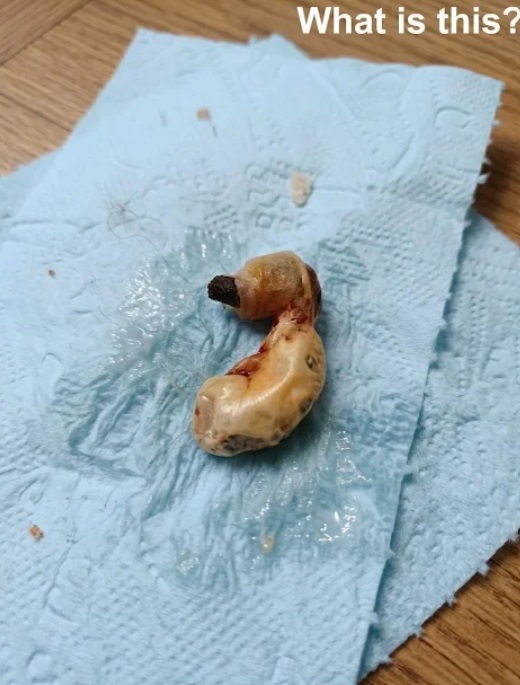
While doing a deep clean in my son’s room, I noticed something strange under the bed. It was pale, curved, and covered in dust. From where I stood, it looked disturbingly organic.
My heart immediately started racing.
Like many people, my mind jumped straight to the worst possibilities. Was it a dead animal? Some kind of insect shell? A forgotten piece of food that had transformed into something unrecognizable?
The fact that I couldn’t identify it made it even more unsettling.
I grabbed a flashlight and looked closer, but somehow the object only seemed stranger. The curved shape and dark tip made it look almost alive.
For a few moments, I seriously considered calling someone for help.
When Imagination Takes Over
It’s funny how quickly the human brain creates stories.
The moment we encounter something unfamiliar, our minds start filling in the gaps. Unfortunately, those explanations are often far more dramatic than reality.
Standing there staring under the bed, I imagined every possibility:
- A dead mouse
- A strange insect
- A piece of shed snake skin
- Something that had been hiding there for months
The longer I looked, the more convincing those theories became.
Yet I had no evidence for any of them.
All I had was an unfamiliar shape.
The Moment of Truth
Eventually, curiosity won.
Using a paper towel, I carefully reached under the bed and picked up the mysterious object.
Within seconds, the mystery disappeared.
It wasn’t dangerous.
It wasn’t alive.
It wasn’t even remotely scary.
It was a simple plastic hair claw clip.
The pale curved section was the body of the clip, while the dark part was simply the metal hinge.
That’s it.
A dusty hair accessory had somehow transformed into a terrifying creature in my imagination.
I couldn’t stop laughing.
My son looked at me and immediately asked:
“That’s just a hair clip?”
Yes. Yes, it was.
Solving the Mystery
The next question was obvious:
How did a hair clip end up under my son’s bed?
After sending a photo to family members, the answer arrived quickly.
A relative who had stayed at our house months earlier immediately recognized it.
She had been looking for that missing clip for ages.
Mystery solved.
What had seemed like a horrifying discovery turned out to be a completely ordinary household item that had simply been forgotten.
Why Our Brains React This Way
Psychologists have long studied something called negativity bias.
Human beings naturally pay more attention to potential threats than harmless situations.
Thousands of years ago, this helped our ancestors survive.
If you heard a noise in the bushes, assuming it was dangerous was often safer than ignoring it.
Today, however, that same survival instinct can sometimes work against us.
Instead of helping us avoid predators, it convinces us that a dusty object under the bed must be something alarming.
When information is missing, our brains often create explanations.
And surprisingly often, those explanations are much scarier than reality.
The Power of Uncertainty
One of the most uncomfortable feelings humans experience is uncertainty.
We like answers.
We like explanations.
When we don’t have them, our minds start searching for possibilities.
The problem is that dramatic explanations tend to grab our attention more than ordinary ones.
A forgotten hair clip is boring.
A mysterious creature hiding under the bed is memorable.
As a result, our brains sometimes choose the exciting story instead of the likely one.
A Lesson Worth Remembering
Looking back, the experience taught me something important.
Most everyday mysteries have simple explanations.
Before assuming the worst, it helps to pause and gather more information.
A closer look often changes everything.
Whether it’s a strange sound, an unfamiliar object, or an unexpected situation, the simplest explanation is frequently the correct one.
That doesn’t mean ignoring genuine concerns.
It simply means allowing curiosity to come before panic.
Practical Tips When You Find Something Strange
If you discover an unfamiliar object in your home, try these steps:
1. Stay Calm
Avoid immediately assuming the worst-case scenario.
2. Improve Visibility
Turn on lights or use a flashlight before drawing conclusions.
3. Observe Carefully
Look at the shape, texture, and size from multiple angles.
4. Use a Tool
If you’re unsure, use a broom, paper towel, or another object to move it safely.
5. Ask Questions
Family members may recognize the item immediately.
6. Do Some Research
A quick photo and image search can often identify unusual objects.
Other Innocent Things That Look Scary
Many ordinary items can seem alarming when discovered unexpectedly:
Hair clips
- Dried pieces of clay or Play-Doh
- Old earbuds
- Twisted socks
- Pet toys
- Dried fruit peels
- Broken plastic pieces
- Small decorative items
Context changes everything.
What looks frightening in a dark corner often becomes completely harmless in daylight.
Final Thoughts
The experience reminded me that not every mystery is a crisis.
Sometimes the object causing stress, anxiety, and endless speculation turns out to be something completely ordinary.
In my case, it was a dusty hair clip hiding under a bed.
For a few minutes, my imagination convinced me it was something far more dramatic.
Thankfully, reality was much less exciting.
The next time you discover something strange around your home, take a deep breath before assuming the worst.
Turn on the light.
Take a closer look.
You may discover that the terrifying mystery you’ve created in your mind is actually just another forgotten everyday object waiting to be found.