
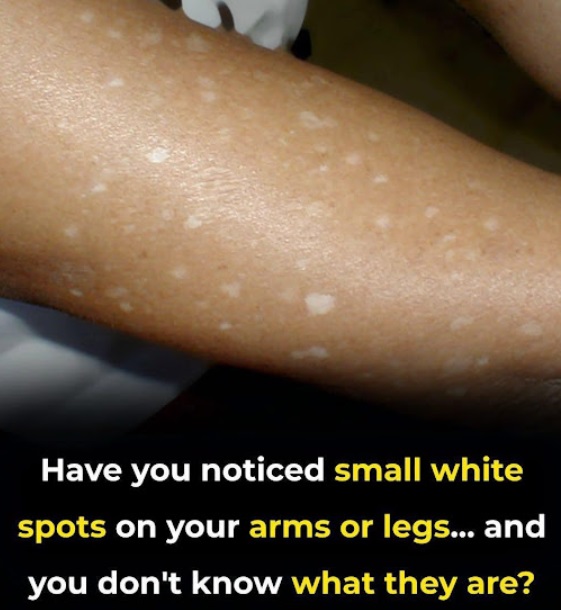
Subtitle: As the last traces of a summer tan begin to fade, many people notice small, pale dots appearing on their legs and arms. If you’ve seen these little patches and wondered what they are—or whether they’re dangerous—the answer may reassure you.
I still remember the first time I noticed them.
I was in my late thirties, standing in front of a full-length mirror after a summer vacation. My arms had a nice, healthy glow from all those days in the sun. But scattered across my forearms and shins were tiny, pale white spots—almost like someone had taken a paintbrush and flicked bleach onto my skin.
I panicked. My first thought was some kind of fungal infection. My second thought was something worse. I spent a solid hour googling “white spots on skin” and convinced myself I had everything from vitiligo to skin cancer.
Then I went to my dermatologist, and she laughed—gently, kindly—and told me I had something called idiopathic guttate hypomelanosis.
“You’re getting older,” she said with a smile. “It’s harmless.”
I didn’t feel old. But I did feel relieved.
If you’ve noticed these small, pale spots on your own arms or legs, let me save you the panic and the googling. Here’s what they are, why they happen, and what you can do about them.
What Are These White Spots?
These spots are commonly known as idiopathic guttate hypomelanosis (IGH) . Although the name sounds intimidating, the condition itself is harmless and very common.
Let’s break down that mouthful of a name:
Idiopathic: The cause is unknown (though we have strong theories).
Guttate: Drop-like, referring to the small, round shape.
Hypomelanosis: Reduced pigment (melanin) in the skin.
In plain English: small, pale spots on the skin where the color has faded.
IGH is not a disease. It’s not an infection. It’s not a sign of a serious health problem. It’s simply a natural change in the skin that becomes more common as we age.
Why Do These Spots Appear?
The leading theory is that these spots are a form of sun damage that builds up over many years. They are not a sign of cancer or a serious disease.
Here’s what happens:
Pigment cells (melanocytes) get damaged. Years of cumulative sun exposure can damage the cells that produce melanin—the pigment that gives your skin its color. In certain areas, these cells stop working entirely, resulting in a localized loss of skin color.
They appear where the skin gets the most sun. IGH typically appears on the shins, forearms, and sometimes the chest and face—areas that get the most sun exposure over a lifetime.
They become more common with age. IGH affects up to 50-80% of adults over 40. You can think of them as a cosmetic sign of photoaging—like freckles, but in reverse.
They are not contagious. You can’t catch them. They won’t spread to other people.
They are not a fungus. Unlike tinea versicolor (another condition that causes white spots), IGH spots usually have a smooth surface and don’t scale or itch.
How to Tell If You Have IGH
If you’re still unsure whether your white spots are IGH or something else, here’s what to look for:
Size: Small, flat, and round, usually 1-5 millimeters across.
Color: Pale white or porcelain-like. They stand out most against tanned or naturally darker skin.
Texture: Smooth. Not scaly, crusty, or rough.
Location: Most commonly on the shins, forearms, and the upper back or chest.
Progression: They appear gradually over time. They don’t grow rapidly or change shape.
Other symptoms: None. IGH doesn’t itch, hurt, or bleed.
If your spots are itchy, scaly, raised, or changing rapidly, see a dermatologist. That could be something else.
What About Other Causes of White Spots?
While IGH is the most common cause on the arms and legs, other conditions can cause similar-looking spots. Here’s how to tell them apart.
Tinea Versicolor: A fungal infection that causes scaly patches, often on the chest and back. Unlike IGH, these spots often have a fine scale and may itch slightly. They are more common in warm, humid climates.
Pityriasis Alba: Often seen in children, these are dry, scaly patches that are common on the face and arms. They are related to eczema or dry skin and tend to fade over time.
Vitiligo: An autoimmune condition that causes larger, smooth, white patches that can grow and merge over time. The patches are often symmetrical and can appear anywhere on the body.
Post-inflammatory hypopigmentation: White spots that appear after a skin injury, like a scrape, burn, or rash. The pigment returns over time.
Guttate psoriasis: Small, drop-like spots that are red or pink, not white. They are usually scaly and itchy.
If you’re unsure, see a dermatologist. They can often diagnose IGH just by looking at your skin—sometimes with the help of a special light called a Wood’s lamp.
Does IGH Need to Be Treated?
The most important thing to know is that IGH is completely benign and does not require treatment. They are not dangerous and won’t progress into anything more serious.
However, since they are permanent and can be a cosmetic concern for some people, here is what you can consider.
Prevention is the most effective strategy. The best way to prevent more spots from appearing is to protect your skin from the sun. Use a broad-spectrum sunscreen on your arms and legs. Wear protective clothing. Avoid prolonged sun exposure during peak hours.
Treatment is for cosmetic reasons only. Because the spots are harmless, any treatment is purely to improve their appearance. A dermatologist can discuss options like:
Prescription creams: Retinoids or topical steroids may help reduce the appearance of spots, though results vary.
- Cryotherapy: Freezing the spots can sometimes help, but it may also cause scarring or pigment changes.
- Laser treatments: Certain lasers can stimulate pigment production, but results are not guaranteed.
- Microneedling: Some people have seen improvement with microneedling combined with topical treatments.
It’s worth noting that success rates vary. Some treatments may not be fully effective. And the spots may still reappear over time.
Frequently Asked Questions
Are IGH spots a sign of skin cancer?
No. IGH is completely benign. It is not a form of skin cancer and does not increase your risk of developing skin cancer.
Can IGH turn into vitiligo?
No. IGH and vitiligo are different conditions. IGH spots are small, stable, and do not spread. Vitiligo spots are larger, can grow, and may appear anywhere on the body.
Can I prevent IGH?
Sun protection is the best prevention. Use sunscreen, wear protective clothing, and avoid prolonged sun exposure. But because IGH is also linked to aging, some spots may still appear even with good sun protection.
Can IGH be reversed?
The spots are usually permanent, but treatments like retinoid creams, lasers, or cryotherapy may reduce their appearance. They will not fully restore the skin’s original pigment.
Do IGH spots get worse with age?
They tend to become more noticeable over time, especially as the surrounding skin continues to age and lose pigment. Sun exposure can also make them more visible.
Can I use self-tanner to cover IGH spots?
Yes. Self-tanner can temporarily darken the skin and make the spots less noticeable. However, because the spots lack pigment, they may still appear slightly lighter than the surrounding skin.
A Final, Reassuring Thought
When I first noticed those little white spots on my arms, I was convinced something was wrong. I spent days worrying, examining my skin, and imagining the worst-case scenarios.
Then I learned that I had something completely normal. Something that millions of people have. Something that wasn’t a disease, wasn’t dangerous, and wasn’t going to hurt me.
It was just my skin aging gracefully—and reminding me to wear sunscreen.
If you’ve got these spots, I hope this article gives you the same reassurance. They’re just a natural part of life. A reminder of all the sunny days you’ve enjoyed. A sign that your skin has been living—and loving—the outdoors.
Protect your skin. Wear sunscreen. And don’t worry about the little white spots. They’re just part of the journey.
Do you have IGH spots on your arms or legs? Did you ever worry about them? Share your story in the comments—let’s normalize talking about the natural changes our bodies go through as we age.