
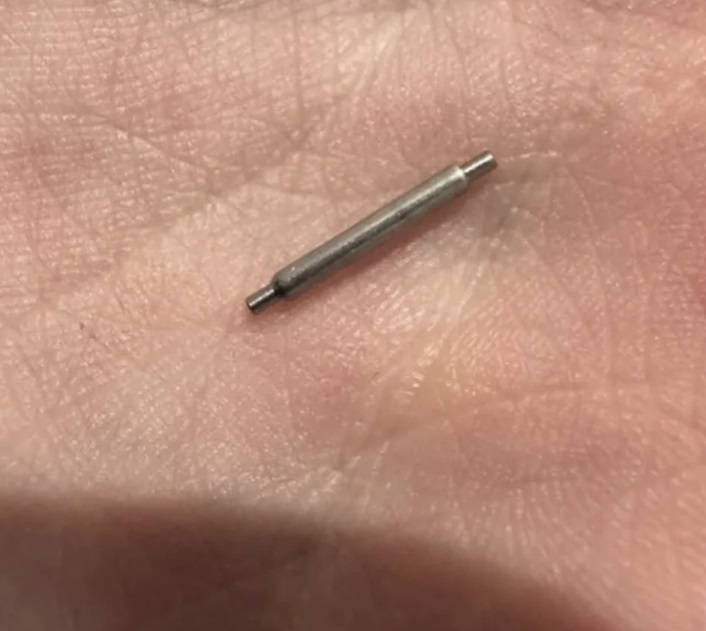
What Is This Tiny Metal Piece? It May Be a Watch Spring Bar
At first glance, this tiny piece of metal can look like nothing more than a pin, a piece of wire, or a broken spring. But if you found one near a watch or while changing a watch strap, there’s a good chance it is a watch spring bar.
Also called a watch band pin or spring pin, this small component connects a watch strap or bracelet to the watch case.
What Is a Watch Spring Bar?
A spring bar is a small metal rod with spring-loaded ends. It fits between the two raised sections on a watch case known as the lugs.
The ends of the bar can be pushed inward. Once the bar is positioned between the lugs and released, the ends extend into small holes or openings, securing the strap.
How Does It Work?
The mechanism is simple:
The bar is compressed while the strap is being installed.
It is positioned between the watch lugs.
The ends extend outward and lock into place.
To remove the strap, the bar is compressed again using a suitable tool.
This allows watch straps to be removed and replaced without permanently attaching them to the case.
Why Is Such a Small Part Important?
Although a spring bar is easy to overlook, it helps keep the watch and strap connected during everyday use.
If the bar becomes damaged, bent, badly corroded, or fails to engage properly, the strap can come loose and the watch may fall.
That is why this tiny component is an important part of a traditional watch strap system, even though it is mostly hidden when the watch is being worn.
Different Types of Spring Bars
Spring bars come in several designs depending on the watch and strap.
Standard spring bars are commonly used with everyday watches.
Heavy-duty spring bars are thicker or stronger and may be used for watches designed for more demanding activities.
Quick-release spring bars have a small lever that allows some straps to be changed without a separate spring-bar tool.
The correct size and type depend on the particular watch.
Why Do Spring Bars Go Missing?
If you find a loose spring bar in a drawer, on a workbench, or near where a watch was repaired, it may simply have fallen out during a strap change.
Spring bars can also become worn or corroded over time. Repeated compression and everyday exposure to moisture can affect their condition.
Before using a loose spring bar again, it is worth checking that it is straight, clean, and functioning properly.
What Happens If a Spring Bar Fails?
A damaged spring bar can allow one side of the strap to detach from the watch. In some cases, this can cause the entire watch to fall.
So while the part itself is inexpensive and easy to overlook, it performs an important job: keeping the watch case connected to its strap.
This is a good example of everyday engineering—a very small component quietly doing an essential job until the moment you need to replace or repair it.