
Some love arrives wrapped in hugs and loud declarations. Other love is quieter—measured, restrained, and easily misunderstood. Growing up, I thought my grandmother’s love belonged firmly in the second category.
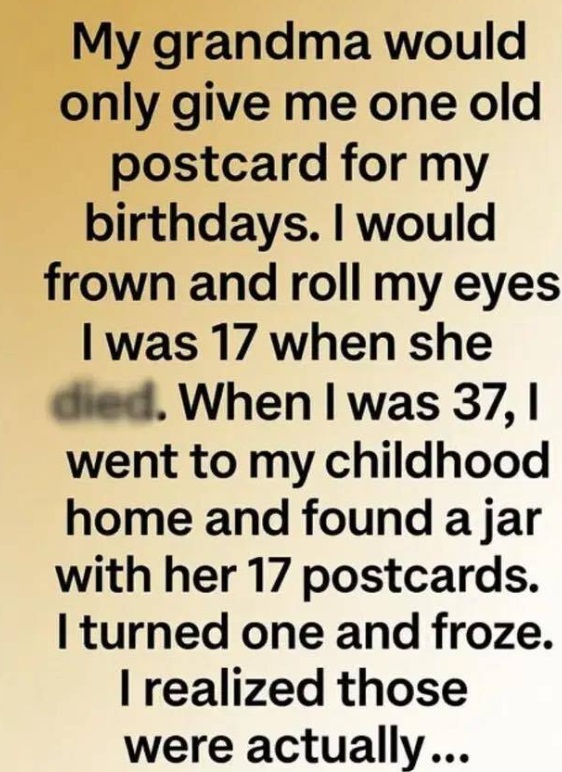
Every year on my birthday, she gave me the same thing: a single, old postcard. No envelope stuffed with cash. No carefully wrapped box. Just a postcard—sometimes faded, sometimes bent, always handwritten. As a teenager, I found it embarrassing. I rolled my eyes, thanked her politely, and tucked it away without a second thought.
When she died, I was 17. I moved on the way young people do—fast, distracted, convinced the future mattered more than the past. It wasn’t until twenty years later, at 37, that I finally understood what she had been trying to tell me all along.
The Postcards I Never Took Seriously
I found them by accident while cleaning out my childhood home—a small glass jar filled with seventeen postcards. One for every birthday she’d been alive for. Seeing them together felt strange, like bumping into an old version of myself I barely recognized.
Each card had one of her familiar “grandma sayings,” the kind I used to dismiss as rambling wisdom:
“Not every door is locked just because it creaks.”
“You’ll never find truth where everyone agrees.”
But this time, something felt different.
On the back of each postcard, certain letters were underlined—always in a different ink color. One letter here. Two letters there. My hands began to shake as I laid all seventeen cards across the kitchen table and started writing the letters down in order.
What emerged stopped me cold.
“LOOK IN THE CEDAR HOPE CHEST. BOTTOM.”
The Hidden Compartment That Changed Everything
The cedar hope chest had sat in her bedroom my entire life. I’d always assumed it held nothing more than old linens and forgotten keepsakes. Still, my heart raced as I lifted the heavy lid and carefully removed its contents.
That’s when I noticed it—a faint seam in the wood.
A false bottom.
Beneath it was a worn red folder, thick with papers. On top sat a yellow sticky note in her unmistakable handwriting:
“Read these when you’re ready to know who I really was.”
I sat on the floor for hours.
The first item was a photograph—my grandmother in her twenties, standing beside a man I had never seen before. His arm rested protectively around her shoulder.
She was pregnant.
The Truth I Was Never Supposed to Know—Until Now
The letters told a story I never imagined. My grandmother hadn’t been my biological grandmother at all.
She was my mother.
She had fled Iran in the early 1970s after falling in love with a journalist her family forbade her to marry. He was targeted by the regime. She escaped. He didn’t. She gave birth to me alone in a refugee shelter in Greece, terrified and without resources.
Unable to care for a baby, she arranged for distant relatives in the U.S. to adopt me. Then she followed, quietly building a life nearby. When I was five, she applied to be our family’s nanny.
She never left my side again.
The postcards weren’t quirks. They were breadcrumbs. A truth given gently, patiently—waiting for the moment I’d finally be ready.
Why This Story Still Haunts Me—in the Best Way
- It redefined everything I thought I knew about love
- It showed me how sacrifice can look invisible from the outside
- It reminded me that family isn’t always built on simple truths
The moments I once misunderstood suddenly made sense—her fierce protectiveness, her quiet distance, the way she seemed to feel my pain before I spoke it.
She was holding onto me the only way she could.
Telling the Truth at Last
I eventually told my adoptive parents everything. There was silence, then tears. Finally, my father said something I’ll carry forever:
“She loved you harder than we ever could. We always knew it. We just didn’t know why.”
We read the letters together. For the first time, the full shape of our family came into focus.
She left me her small bungalow in Oregon. I moved there after my divorce, burned out and searching for peace. That house became my sanctuary.
And now, I write postcards of my own—to my daughter.
The Lesson She Left Behind
Love isn’t always loud.
Sometimes it whispers for decades.
Not all secrets are betrayals. Some are acts of courage, wrapped in silence and shaped by an unending, patient love.
And if you’re lucky enough, the truth always finds its way home.