
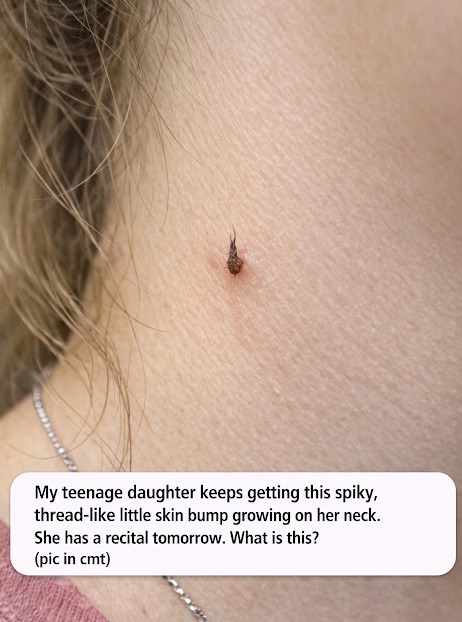
What Is This Tiny Spiky Bump on My Daughter’s Neck?
When your teenage daughter notices a tiny, thread-like bump on her neck right before an important recital, it can suddenly become the only thing she sees in the mirror.
A small skin growth can have several possible causes. One possibility is a filiform wart, but skin tags, irritated hair follicles, ingrown hairs, and other benign growths can sometimes look similar. Because of that, appearance alone isn’t enough to make a definite diagnosis.
Before the recital, the safest approach is simple: avoid picking, cutting, or applying harsh treatments to the area.
What Is a Filiform Wart?
A filiform wart is a type of wart associated with certain strains of human papillomavirus (HPV). Unlike the rough, rounded warts commonly seen on hands, these warts are usually narrow, elongated, and finger-like.
They may appear:
Flesh-colored, pink, or slightly darker
Thin or thread-like
Smooth or somewhat rough
As a single growth or in a small cluster
They can occur around the face and neck and may become irritated when rubbed by clothing, jewelry, or hair.
Could It Be a Skin Tag?
Yes. A skin tag can also appear as a small growth attached to the skin by a narrow stalk.
Skin tags are often:
Soft and smooth
Flesh-colored or slightly darker
Floppy or teardrop-shaped
A filiform wart tends to look more pointed or finger-like, but there can be considerable overlap. A healthcare professional may need to examine the growth to tell the difference.
Other possibilities include an ingrown hair or irritated follicle, especially if the area is red, tender, or located near hair-bearing skin.
What Should You Do Before the Recital?
For tonight, keep things gentle.
Wash the area normally and pat it dry. Try to avoid necklaces, costume collars, hair, or other items repeatedly rubbing against the bump.
If the skin is intact and not irritated, normal makeup may help make a small bump less noticeable. However, avoid applying makeup over skin that is broken, bleeding, or inflamed.
Most importantly, don’t try to cut, burn, pull, or aggressively scrape the growth before the recital. An unfamiliar skin growth may not actually be a wart, and unnecessary treatment can cause irritation, bleeding, or scarring.
When Should It Be Checked?
Consider having the growth examined by a doctor or dermatologist if it:
Keeps getting larger
Changes color or shape
Becomes painful
Bleeds without being injured
Becomes very red or swollen
Produces drainage
Is repeatedly irritated
Doesn’t go away or continues changing
A healthcare professional can determine what type of growth it is and whether treatment is necessary.
Can a Filiform Wart Spread?
Warts can spread from one area of skin to another through contact. Picking or scratching the growth may increase the chance of spreading it to nearby skin.
Try not to manipulate the bump, wash your hands after touching it, and avoid sharing personal items such as razors or towels that come into direct contact with the area.
Can You Remove It at Home?
It’s better not to assume that an unidentified neck growth is a wart and treat it yourself.
Some over-the-counter wart products can irritate the skin, and treatments intended for warts may not be appropriate for other types of growths. If removal is desired, a healthcare professional can first identify the growth and recommend an appropriate treatment.
Frequently Asked Questions
Is a tiny spiky neck bump always a wart?
No. A filiform wart is one possibility, but skin tags, ingrown hairs, irritated follicles, and other skin growths can look similar.
Can I cut it off myself?
It’s safer not to cut or remove an unidentified growth. Doing so can cause bleeding, infection, scarring, and further irritation.
Should I use salicylic acid?
Don’t automatically use a wart-removal product just because a bump looks like a wart. It’s better to know what you’re treating first, particularly when the growth is on the neck.
Should my daughter miss her recital?
A small skin bump by itself doesn’t necessarily mean she needs to miss an event. However, if it is painful, bleeding, rapidly changing, or showing signs of infection, consider having it evaluated.
Final Thoughts
A tiny, spiky bump on the neck can look concerning, especially right before a special event. A filiform wart is one possible explanation, but it isn’t the only one.
For now, keep the area clean, minimize friction, and avoid aggressive home removal. If the bump persists, changes, becomes painful, or you’re simply unsure what it is, a healthcare professional can examine it and provide a more reliable answer.
And before the recital, remember: a tiny skin bump is unlikely to be nearly as noticeable to the audience as it is to someone staring at it in the mirror.