
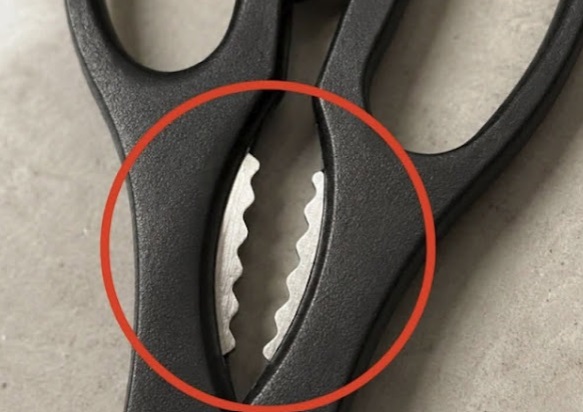
What Is the Strange Toothed Part on Kitchen Scissors Actually For?
Have you ever picked up your kitchen scissors and noticed the little row of teeth tucked between the handles? It is one of those small kitchen details that is easy to overlook, especially when you have been using the same pair of scissors for years.
That unusual section is not always just a decorative detail. On many kitchen shears, the ridged area is designed to provide extra grip, helping hold certain objects in place when you squeeze the handles together. Depending on the design, it may function as a jar grip, nutcracker, or another type of gripping tool.
But here is the interesting part: not every pair of kitchen scissors is built the same way. Understanding the feature on your particular model can help you use it properly and avoid damaging your scissors.
Let’s take a closer look at what that toothed section may be designed to do, how to use it safely, and which common kitchen tasks are better left to specialized tools.
What Is the Toothed Section on Kitchen Scissors?
The ridged section between the handles of some kitchen shears is often designed to grip objects more securely than smooth surfaces would.
When the handles are squeezed together, the textured surfaces can help hold a suitable object in place. Depending on the shape and construction, the feature may be intended for gripping jar lids, cracking certain nuts, or helping secure particular food items during preparation.
Manufacturers use different designs, so there is no single function that applies to every pair of kitchen scissors. The owner’s manual or product description is the best way to confirm what your model can safely handle.
1. It May Help Open Certain Jar Lids
A stubborn jar lid can turn a simple cooking task into a frustrating experience. If your kitchen shears have a designated jar-gripping feature, it may provide extra leverage or grip when opening compatible lids.
How to use it safely:
- Check the manufacturer’s instructions to confirm that the gripping section is suitable for jar lids.
- Position the lid within the designated gripping area.
- Apply gentle, controlled pressure.
- Turn carefully without placing your fingers near the cutting blades.
Never force the lid if it slips or the scissors do not fit securely around it. Thin metal lids can bend, and sudden slipping can cause an injury.
For particularly stubborn jars, a rubber jar opener or a purpose-built lid-opening tool is usually a better choice.
2. It May Work as a Small Nutcracker
Some kitchen shears feature a reinforced, toothed area designed to crack suitable nuts. If your model specifically includes this function, it can be handy when a dedicated nutcracker is not available.
Before trying it, make sure the nut fits securely in the intended gripping section. Apply gradual pressure and stop if the shell does not crack easily.
Avoid using excessive force, especially on very hard shells. Nuts can slip unexpectedly, and forcing the tool may damage the gripping mechanism or cause an injury.
A dedicated nutcracker remains the better option for large or particularly hard nuts.
3. Some Poultry Shears Use a Notch to Grip Bones
Heavy-duty poultry shears sometimes include a specially shaped notch intended to help grip small bones or secure joints during food preparation.
This feature varies by model. A gripping notch does not necessarily mean the scissors are designed to cut through bones, and ordinary kitchen scissors should not be used for that purpose.
If you are preparing raw chicken, use poultry shears specifically designed for the task and follow the manufacturer’s directions. Keep your fingers clear of the blades and gripping teeth, and never force the tool through a thick bone.
Afterward, wash your hands and clean and sanitize the shears and any surfaces that contacted raw poultry.. Some Poultry Shears Use a Notch to Grip Bones
Heavy-duty poultry shears sometimes include a specially shaped notch intended to help grip small bones or secure joints during food preparation.
This feature varies by model. A gripping notch does not necessarily mean the scissors are designed to cut through bones, and ordinary kitchen scissors should not be used for that purpose.
If you are preparing raw chicken, use poultry shears specifically designed for the task and follow the manufacturer’s directions. Keep your fingers clear of the blades and gripping teeth, and never force the tool through a thick bone.
Afterward, wash your hands and clean and sanitize the shears and any surfaces that contacted raw poultry.
4. It Can Provide Extra Grip for Certain Objects
On some models, the toothed section serves a more general purpose: helping hold suitable objects securely.
Depending on the design, it may be intended for particular caps, small food items, or other objects specified by the manufacturer.
The important thing is to use the gripping section only for objects that fit securely and are appropriate for the tool. Avoid gripping glass, brittle plastic, or anything that could crack or slip suddenly.
If an object does not fit naturally into the notch, do not force it. A dedicated opener or nonslip gripping pad may be safer and more effective.
Other Kitchen Scissors Features Worth Knowing About
The gripping section is not the only useful feature found on kitchen shears. Some models include additional details that make everyday food preparation easier.
Built-In Bottle Openers
Certain kitchen shears include a specially shaped opening or hook designed to open compatible bottles. Look for a clearly identifiable bottle-opening feature rather than assuming the toothed section can do the job.
Detachable Blades
Some models separate into two pieces, allowing easier cleaning around the pivot and along the blades. Only take your shears apart if the manufacturer specifically designed them to separate.
Serrated Cutting Edges
Small serrations along the cutting blades can help grip slippery ingredients during cutting. These are different from the gripping teeth located between the handles.
Heavy-Duty Blades
Poultry shears may feature reinforced construction for specific cutting tasks. Ordinary kitchen scissors are not necessarily suitable for cutting joints, cartilage, or bones.
How to Clean and Maintain Kitchen Scissors
Kitchen shears come into contact with food, so regular cleaning is important, particularly after preparing raw meat or poultry.
- Clean them after use. Follow the manufacturer’s washing instructions and remove food particles from the teeth, blades, and pivot joint.
- Dry them thoroughly. This helps prevent moisture-related corrosion on metal components.
- Inspect the joint. Food residue can accumulate where the blades meet, so clean this area carefully while keeping your fingers away from the cutting edges.
- Use the safety lock. If your scissors have a locking mechanism, close and secure them according to the instructions before storage.
- Check for damage. Loose joints, cracked handles, and damaged blades can make the tool difficult to control.
- Store them securely. Keep sharp scissors in a designated organizer or another safe place, away from children.
If your kitchen shears are dishwasher-safe, follow the manufacturer’s guidance for washing and drying.
Common Mistakes to Avoid
Even a useful kitchen feature can cause problems when it is used for the wrong task.
- Do not assume every toothed section is designed to open jars or crack nuts.
- Do not use ordinary scissors to cut thick bones.
- Do not squeeze excessively when an object will not fit or move.
- Keep your fingers away from the cutting blades and pinch points.
- Do not use scissors with loose joints or damaged handles.
- Clean and sanitize kitchen shears appropriately after contact with raw poultry.
When you are unsure about a feature, check the product instructions before experimenting.
Frequently Asked Questions
What is the jagged part between kitchen scissor handles called?
It is generally a gripping section or gripping notch. Depending on the model, it may also be described as a jar opener, nutcracker, or bone-gripping feature.
Can all kitchen scissors open jars?
No. Only use this feature for opening jars if the manufacturer identifies it as suitable for that purpose.
Can I crack walnuts with kitchen scissors?
Some kitchen shears are designed to crack certain nuts, but others are not strong enough. Check the manufacturer’s instructions and use a dedicated nutcracker if the scissors are not intended for this task.
Is the toothed section designed to cut bones?
Not necessarily. Some poultry shears have a notch to grip bones or joints, but that does not mean the notch itself can cut through them. Use tools specifically designed for the intended cutting task.
How do I know what my scissors are designed to do?
Look for the model number, packaging, manufacturer’s website, or instruction manual. These sources can help you identify the intended function and any usage limitations.
Final Thoughts
That little toothed section between the handles of your kitchen scissors may have a practical purpose beyond its unusual appearance. On some models, it provides extra grip or serves as a specialized feature for tasks such as opening compatible lids or cracking certain nuts.
The key is remembering that kitchen shears are not all designed alike. A feature that works well on one model may be unsuitable for another.
Take a moment to inspect your scissors and check the manufacturer’s instructions. You may discover a useful feature that has been hiding in plain sight in your kitchen drawer all along.