
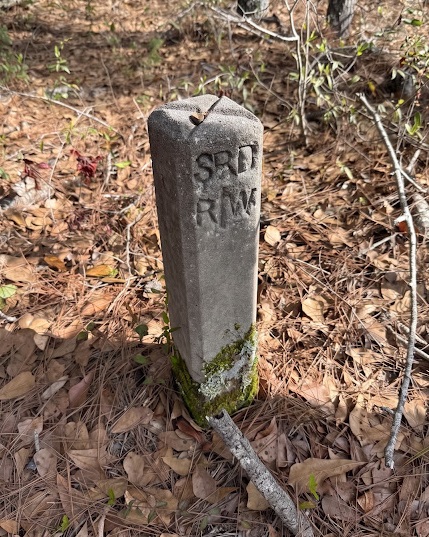
You can be walking along an old railroad bed, forgotten trail, or wooded path when you suddenly notice a knee-high concrete post standing beside the way.
At first, it may look like nothing more than an old piece of concrete.
But it could be a clue to the history of the road or transportation route that once passed through the area.
What Is This Concrete Marker?
The marker appears to be a State Road Department right-of-way marker, with “R/W” generally meaning “right of way.”
A right-of-way marker was used to identify the boundary of a transportation corridor. It helped indicate where the official road property or right of way began or ended.
That doesn’t necessarily mean the marker shows the edge of the pavement. A road’s right of way could include shoulders, drainage areas, and other parts of the corridor.
Why Is It Still There?
Old roads often disappear long before every trace of them is gone.
A route may have been replaced, relocated, widened, or abandoned. Over time, vegetation covers the roadbed and natural erosion changes the landscape.
Concrete, however, can remain in place for decades.
That means a small marker can survive long after the road, signs, and other infrastructure have disappeared.
Clues That an Old Road Was Here
If you find a concrete marker beside an overgrown path, look at the surrounding area for additional evidence.
You might notice:
A straight or unusually level route
Old gravel or crushed stone
Drainage ditches
Culverts
Other concrete or metal markers
Remnants of old fencing or roadside infrastructure
One clue doesn’t necessarily prove the history of a location, but several clues together can tell a much stronger story.
Old maps and local records can also help confirm whether a former road existed there.
What If It’s Near an Old Railroad Bed?
A marker near an old railroad alignment should be considered carefully. Trails sometimes follow former rail lines, cross old roads, or pass through areas that once contained several types of transportation infrastructure.
So it’s better not to assume exactly what the marker represents based on its location alone.
The surrounding landscape and historical records can provide important context.
Why These Small Markers Are Interesting
Large historic structures are easy to recognize.
A bridge, station, or historic building immediately tells you that something important once happened there.
A small concrete post is different.
It was built for a practical purpose, not as a monument. But decades later, it can become an important physical clue to how roads were surveyed, planned, and maintained.
The road may be gone, but the marker can still point toward its history.
Is It Safe to Explore Old Roadbeds?
“Abandoned” doesn’t always mean safe.
Old transportation routes may contain unstable structures, hidden holes, steep embankments, broken glass, rusty metal, or private property. Some areas may also have restrictions on access.
If you’re exploring, stay on permitted routes, avoid unstable structures, and be careful around anything buried or damaged.
If digging is necessary, identify underground utilities before disturbing the ground.
Frequently Asked Questions
What does R/W mean on a road marker?
R/W generally stands for right of way, referring to the legally established corridor associated with a road or other transportation route.
Does a right-of-way marker show the edge of the pavement?
Not necessarily. The right of way can extend beyond the actual road surface.
Why would the marker remain after the road disappeared?
Concrete markers can survive for many years, while road surfaces, signs, and other infrastructure gradually deteriorate or become covered by vegetation.
Does finding one prove there was an old road?
Not by itself. The marker is a clue. Old maps, records, roadbed features, and other physical evidence can help confirm its purpose.
Could there be more markers nearby?
Possibly. The number and location of surviving markers depend on the original installation and what has remained over the years.
Final Thoughts
A small concrete road marker may not look important at first.
But it can represent much more than a piece of old concrete. It may provide evidence of surveying, transportation planning, property boundaries, and a road that disappeared from the landscape long ago.
That’s what makes these discoveries so interesting.
History doesn’t always survive as a famous landmark. Sometimes it’s a knee-high concrete post sitting quietly beside an overgrown trail, waiting for someone to stop and take a closer look.