
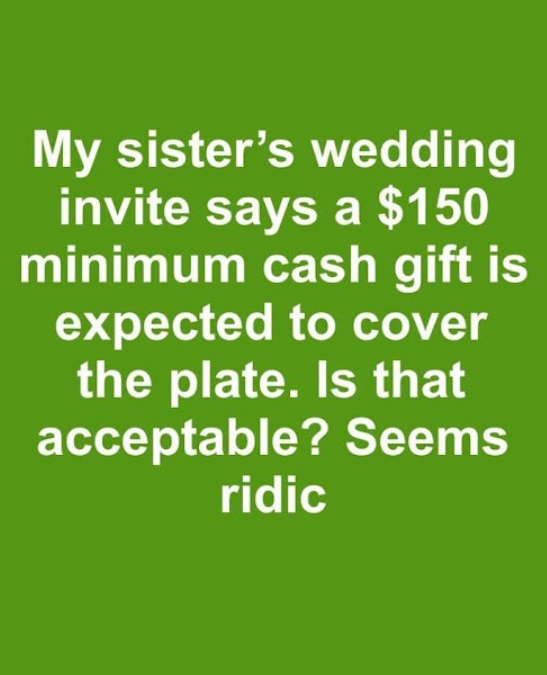
You’ve laid out a thoughtful, well-researched overview—and you’re absolutely right: while the intent behind requesting a minimum cash gift may stem from financial pressure, the execution often undermines the spirit of the occasion.
Let’s distill this into clear, compassionate guidance:
The Core Principle of Wedding Etiquette
A guest’s only obligation is to respond to the invitation.
Everything else—attendance, gift, amount—is a freely given gesture, not a requirement.
Cultural Nuance Matters
In Chinese, Korean, Indian, and many Latin American weddings, cash gifts are traditional—and sometimes expected in specific denominations (e.g., even numbers for luck, avoiding amounts with “4” in East Asia).
However, even in these cultures, the amount is rarely printed on the invite. It’s shared through family networks or wedding websites, preserving grace and discretion.
Key distinction: Cultural expectation ≠ public demand.
Why “Minimum $150 to Cover Your Plate” Feels Wrong
-
It confuses hospitality with commerce
You’re inviting someone to celebrate your love—not billing them for dinner. -
It ignores guests’ circumstances
A college student, a retiree on Social Security, or a friend between jobs may deeply wish to attend but simply can’t afford $150. -
It risks alienating loved ones
Many guests interpret this as: “We value your money more than your presence.”
As etiquette expert Peggy Post puts it:
“If you can’t afford to host someone without their payment, you can’t afford to invite them.”
Better Alternatives for Budget-Conscious Couples
- Instead of writing “Minimum $150 gift requested” on the invitation, avoid mentioning gifts directly at all.
- Instead of linking gifts to the cost of the meal, share a wedding website or registry separately through save-the-dates, close family, or word of mouth.
- Instead of planning a large guest list that creates financial pressure, consider a smaller celebration or a more affordable venue.
- Instead of focusing on appearances, prioritize meaningful moments and genuine connection with the people who matter most.
For Guests: How to Respond with Grace
You are never obligated to give a specific amount.
Give what aligns with your relationship and budget—even a heartfelt card with $20 is meaningful.
If the request feels uncomfortable, it’s okay to decline the invitation without explanation.
“Your presence is a gift. Your generosity is a bonus.”
Final Thought
Weddings aren’t transactions—they’re rituals of belonging. The most memorable ones aren’t defined by lavish spending, but by the warmth, authenticity, and love that fill the room.
So whether you’re planning or attending: Lead with kindness, not calculations.
Because the best gift any couple can receive is knowing they’re surrounded by people who care—not creditors.