
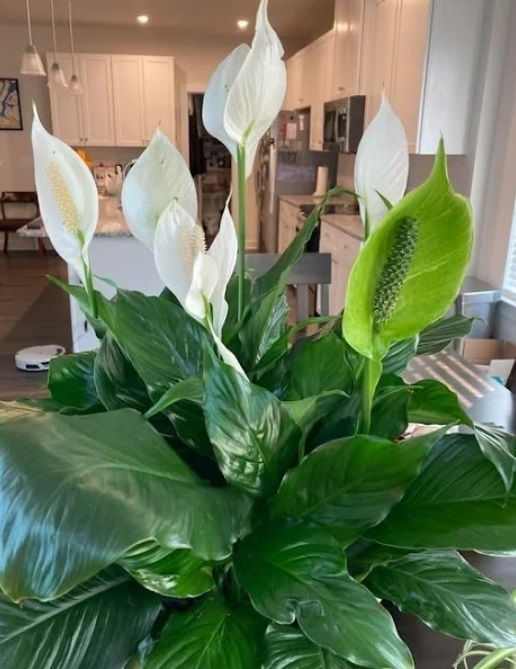
If you’ve ever watched your peace lily produce that first elegant white bloom—arching proudly above its glossy green leaves—you know the quiet joy it brings. It feels like a vote of confidence from your plant: “You’re doing great. Keep going.”
I still remember the morning I saw my first peace lily flower. I’d had the plant for nearly two years. It was healthy—dark green leaves, no brown tips, steady growth. But no flowers. I started to wonder if I had a defective peace lily. A plant that was afraid of commitment.
Then one day, I noticed a small green shoot emerging from the center of the leaves. It looked different—thicker, paler. I watched it for days, not daring to hope. And then, slowly, it began to lift. A white spathe unfurled, revealing the tiny spadix inside. I texted a photo to my plant-obsessed friend: “IS THIS A FLOWER?”
She replied, “Congratulations. You are now a real plant parent.”
That moment of joy is what keeps us caring for our green friends. But let’s be honest: many peace lilies spend months (or years!) as lovely leafy houseplants… with zero flowers. You water, you mist, you talk to it—but still, no blooms.
If that sounds familiar, don’t despair. You’re not doing anything wrong. You’re just missing a few key triggers.
Let me walk you through exactly how to convince your peace lily to flower—and keep flowering—all year long.
First, Understand Why Peace Lilies Flower (The Biology)
Before we fix the problem, let’s understand the plant.
Peace lilies (Spathiphyllum) are not true lilies. They’re tropical aroids native to Central and South America. In the wild, they grow on rainforest floors, receiving dappled light, consistent moisture, and warm temperatures.
The “flower” isn’t actually a flower. The white structure is a modified leaf called a spathe. The tiny bumps on the central spike (spadix) are the actual flowers. The spathe attracts pollinators. After pollination, the spathe turns green and eventually fades.
Why do peace lilies flower? To reproduce. When conditions are right (light, temperature, humidity, nutrition), the plant produces blooms to attract pollinators and produce seeds.
Why don’t they flower? Something is missing from that equation. The plant is happy enough to survive, but not quite happy enough to reproduce.
Your job is to figure out which trigger is missing.
Expert Tip #1: Give It Bright, Indirect Light (Not Sun, Not Shade)
This is the #1 reason peace lilies don’t flower. They’re often sold as “low-light plants,” which is true—they will survive in low light. But they won’t thrive. And they certainly won’t bloom.
The problem: A peace lily in a dark corner will produce lush, dark green leaves (it’s reaching for light). But without enough energy, it won’t produce flowers.
The solution: Move your peace lily to a spot with bright, indirect light. Near an east-facing window is ideal. A few feet back from a south- or west-facing window also works. If the light is too harsh (direct sun), the leaves will scorch (yellow or brown patches).
The test: Can you read a book in that spot without turning on a lamp? If yes, the light is probably sufficient. If the room feels dark even during the day, your peace lily needs more light.
Pro tip: Rotate your plant every few weeks so all sides receive light. Otherwise, it will lean toward the window (and flowers may face away from the room).
Expert Tip #2: Water Consistently (But Don’t Drown It)
Peace lilies are dramatic about water. They’ll droop dramatically when thirsty, then perk up within hours of watering. That’s fine for survival, but consistent moisture is better for blooming.
The problem: Letting your peace lily wilt repeatedly stresses the plant. Stressed plants focus on survival, not reproduction.
The solution: Water when the top inch of soil feels dry to the touch. Don’t wait for the plant to droop. Use room-temperature water (cold water shocks the roots).
Signs of overwatering: Yellow leaves, brown leaf tips, mushy stems, fungus gnats, or a musty smell from the soil. Overwatering is more dangerous than underwatering (it causes root rot).
The Goldilocks zone: Consistently moist but not soggy.
Pro tip: Use distilled or filtered water if your tap water is hard or chlorinated. Peace lilies are sensitive to chemicals, which can cause brown leaf tips.
Expert Tip #3: Boost Humidity (These Are Tropical Plants)
Peace lilies are native to humid rainforests. Average household humidity (30-40%) is often too low for flowering.
The problem: Low humidity causes brown leaf tips and reduces the plant’s overall vigor. A stressed plant won’t bloom.
The solution: Increase humidity around your peace lily.
Easy methods:
Mist the leaves daily (morning is best, so water doesn’t sit overnight).
Use a humidity tray: Place a tray of pebbles filled with water under the pot (the pot should sit on the pebbles, not in the water).
Group plants together: Plants release moisture through transpiration. Grouping creates a microclimate.
Use a humidifier: Especially in winter when indoor air is driest.
Place it in a bathroom (if there’s enough light) – showers create natural humidity.
Pro tip: If leaf tips are already brown, trim them at an angle (following the natural leaf shape). This improves appearance and may reduce further browning.
Expert Tip #4: Feed It (But Not Too Much)
Peace lilies are not heavy feeders, but they need nutrients to produce flowers.
The problem: No fertilizer means no blooms. Too much fertilizer (especially high-nitrogen) produces lush green leaves but no flowers.
The solution: Use a balanced, water-soluble fertilizer (like 20-20-20 or 10-10-10) diluted to half strength.
Schedule: Feed every 4-6 weeks during spring and summer (growing season). Do not fertilize in fall and winter (the plant is resting).
Flower-boosting tip: Look for fertilizer with a higher middle number (phosphorus), which promotes blooming. For example, 10-20-10.
Warning signs of over-fertilizing: Brown leaf tips, white crust on soil surface, or salt buildup around the rim of the pot. If you see these, flush the soil with water and reduce fertilizer.
Pro tip: Always water before fertilizing (never apply fertilizer to dry soil – it can burn roots).
Expert Tip #5: Give It a Rest (Mimic Seasons)
Peace lilies naturally bloom in spring and summer. They need a rest period in fall and winter to build energy for the next flowering cycle.
The problem: If your home is the same temperature and light level year-round, your peace lily may never get the signal to bloom.
The solution: Mimic the seasons.
Fall/Winter (rest period): Reduce watering (let the soil dry slightly more between waterings). Stop fertilizing. Move it to a slightly cooler spot (60-65°F / 15-18°C). It’s okay if growth slows – that’s the point.
Late winter/early spring (wake-up period): Gradually increase watering. Move it to a brighter spot. Resume fertilizing. This mimics the natural transition from dry/cool season to wet/warm season, triggering the plant to bloom.
Pro tip: About 6-8 weeks before you want flowers, start the “wake-up” routine. Many peace lilies will produce blooms within 2-3 months.
Expert Tip #6: Repot When Necessary (But Not Too Often)
Peace lilies actually bloom best when they’re slightly root-bound. If you repot too often (or into a pot that’s too large), the plant will focus on growing roots instead of flowers.
The problem: A peace lily in a giant pot will put all its energy into filling the pot with roots. You’ll get lush leaves but no flowers.
The solution: Repot only when the roots are visibly crowded (growing out of the drainage holes or circling the top of the soil). When you repot, choose a pot only 1-2 inches larger in diameter.
Signs it’s time to repot:
Roots emerging from drainage holes
Water runs straight through without soaking in
The plant wilts frequently (roots can’t take up enough water)
It’s been 2-3 years since the last repot
Best time to repot: Spring, just before the growing season.
Pro tip: When repotting, gently loosen the root ball and remove any dead or rotting roots. Use fresh, well-draining potting mix (regular potting soil mixed with perlite or orchid bark).
Expert Tip #7: Remove Spent Blooms (Redirect Energy)
Once a peace lily flower fades, it will turn green and eventually brown. Leaving it on the plant wastes energy that could go toward new blooms.
The problem: The plant is still sending nutrients to a dying flower.
The solution: Cut off spent blooms at the base of the stem (as close to the soil line as possible). Use clean, sharp scissors or pruning shears.
How to identify spent blooms: The white spathe will turn green, then brown, and eventually shrivel. Cut it off when it starts looking tired.
Pro tip: Also remove any yellow or damaged leaves. This directs energy toward healthy growth and blooming.
Bonus Tip: Patience (Flowers Take Time)
Peace lilies don’t bloom on command. Even with perfect care, it can take months for a peace lily to produce its first flower (or its next flower).
The timeline:
After correcting light, water, and fertilizer issues: Expect blooms in 2-6 months.
After repotting: The plant may take a season off to adjust. Be patient.
Mature plants bloom more readily than young plants. If your peace lily is still small (less than 12 inches tall), give it time to grow.
Don’t give up. If your peace lily is healthy (green leaves, steady growth), you’re doing something right. The flowers will come.
Common Peace Lily Problems (And Solutions)
No Flowers
Likely Causes:
Not enough light
No seasonal rest period
Too much nitrogen fertilizer
Solutions:
Move the plant to a brighter location with indirect light
Allow a natural seasonal growth cycle
Switch to a bloom-boosting fertilizer
Brown Leaf Tips
Likely Causes:
Low humidity
Over-fertilizing
Chemicals in tap water
Solutions:
Increase humidity around the plant
Reduce fertilizer applications
Use filtered or distilled water if needed
Yellow Leaves
Likely Causes:
Overwatering (most common)
Natural aging of older leaves
Solutions:
Let the top inch of soil dry slightly between waterings
Ensure the pot has good drainage
Remove yellowing leaves
Drooping Leaves
Likely Causes:
Underwatering
Overwatering (check soil moisture)
Solutions:
Water thoroughly when the soil begins to dry
Maintain consistent moisture without leaving soil soggy
🪴 No Growth
Likely Causes:
Root-bound plant
Cool temperatures
Dormant season
Solutions:
Repot if roots are crowded
Move to a warmer location
Be patient during winter dormancy
Flowers Turning Green
Likely Causes:
Normal aging of blooms
Excessive light exposure
Solutions:
Remove spent flowers
Move to a slightly lower-light location if blooms turn green quickly
Frequently Asked Questions
How often do peace lilies bloom?
Mature plants can bloom 2-3 times per year, typically in spring and summer. Some varieties bloom more frequently.
How long do peace lily flowers last?
Each bloom lasts 1-2 weeks, sometimes longer in cool conditions. The white spathe gradually turns green as it ages.
Can a peace lily flower in winter?
It’s possible if conditions are right (warm temperatures, bright light), but it’s not typical. Most peace lilies naturally bloom in spring and summer.
Should I cut off green peace lily flowers?
No. If the spathe is still white or pale green, it’s still healthy. Cut it off only when it turns brown and begins to shrivel.
Why did my peace lily stop flowering after repotting?
The plant is focusing on root growth. Give it time (a season or two) to settle in. It will resume flowering once established.
Can I force my peace lily to flower?
You can create optimal conditions, but you can’t force it. The plant will flower when it’s ready.
My peace lily has never flowered. Is it defective?
No. Peace lilies can live for years without flowering, especially in low-light conditions. Address the issues above, and be patient.