
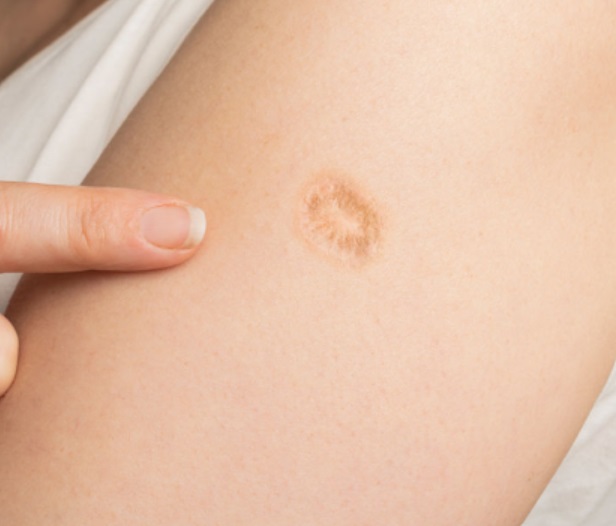
If you’ve ever noticed a small, perfectly round scar on your upper arm, you’re not alone. Millions of people around the world carry this subtle mark—often without knowing its story.
For years, it sparked myths: a childhood burn, a strange skin infection, even a ritual mark. In reality, it’s something far more meaningful—a reminder of one of humanity’s greatest public health victories.
What Is That Round Scar?
It’s the vaccination scar from the smallpox vaccine, part of a global effort led by the World Health Organization to eliminate one of history’s deadliest diseases.
Between the 1950s and early 1980s, the vaccine was administered using a unique technique:
- A bifurcated needle dipped in live vaccinia virus (a relative of smallpox)
- The skin was pricked multiple times in a small circular area
- A controlled local reaction formed: blister → pustule → scab → permanent scar
The result was a small, coin-shaped mark—usually on the upper arm.
Why Do Some People Have It—and Others Don’t?
In 1980, the World Health Organization officially declared smallpox eradicated. Routine vaccination programs then ended in most countries.
- People born before the early 1980s in many parts of Asia, Africa, Latin America, and Eastern Europe likely received it.
- In countries like the United States, civilian vaccination ended earlier (1972), so younger generations usually don’t have the scar.
- Some military personnel and healthcare workers were vaccinated later due to specific risk considerations.
Smallpox remains the only human disease ever eradicated worldwide—a milestone in medical history.
Common Misconceptions—Debunked
1. “It’s from a burn or skin disease.”
It was an intentional immune response—not an accident.
2. “It’s from a TB test.”
The tuberculin skin test leaves no scar. The BCG vaccine for tuberculosis can leave a small mark, but it’s usually different in appearance.
3. “It means I had smallpox.”
No. The vaccine used vaccinia virus, which stimulated immunity without causing smallpox.
4. “It’s contagious.”
The scar is simply healed skin. There is no active virus.
Why Was This Vaccine Different?
Unlike modern injections delivered beneath the skin, the smallpox vaccine worked through superficial skin punctures that triggered a strong local immune response. The visible reaction was actually proof that the body was building protection.
A Symbol of Global Cooperation
At the height of the Cold War, countries—including the United States and the Soviet Union—supported a coordinated eradication campaign. Health workers traveled door to door across continents to stop transmission.
That small circular scar represents science, cooperation, and collective action on a global scale.
Final Thought
That mark isn’t a flaw.
It’s a reminder that coordinated public health efforts can change the course of history.
Some scars aren’t wounds. They’re victories.