
Engaging Introduction
Let me tell you about the moment I stared at an old car’s dashboard and felt completely lost.
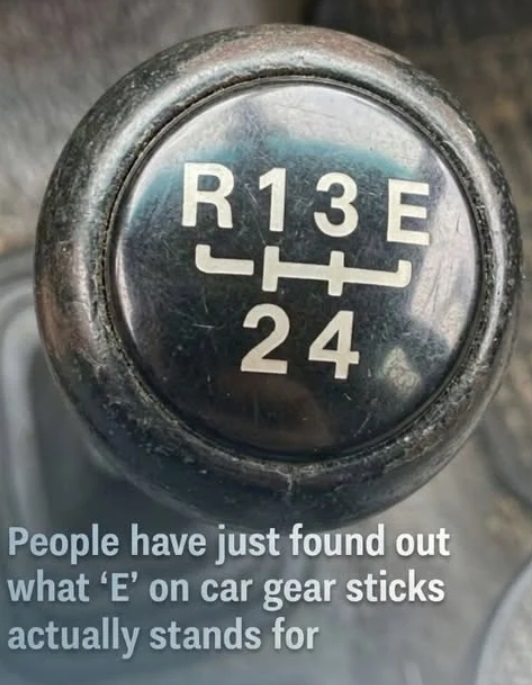
I was helping a friend move his late father’s car—a 1980s sedan that had been sitting in a garage for years. The upholstery smelled like memories. The radio was analog. And the gear shift had a letter I’d never seen before: “E.”
I knew P, R, N, D, and even L or 2. But E? What on earth was E?
“Electric?” I guessed. “Emergency?” “Exit?”
My friend shrugged. He didn’t know either. We spent a good five minutes debating before I finally pulled out my phone. The answer surprised us both.
For decades, most drivers never gave much thought to the letters on a car’s gear selector. “P” meant Park. “R” meant Reverse. “D” meant Drive. Simple enough.
But recently, many younger drivers have been surprised to discover an unfamiliar letter appearing on some older vehicles: “E.”
At first glance, people assumed it might stand for “Electric” or some forgotten transmission setting. But the truth is far more interesting. Long before modern fuel-saving technology and smart computerized driving systems, the mysterious “E” stood for Economy mode — an early attempt by automakers to improve fuel efficiency during everyday driving.
Let me walk you through the fascinating history of this forgotten gear, why it disappeared, and why a new generation is just now discovering it.
What Does “E” Actually Stand For?
E = Economy.
Yes, it’s that simple. Economy mode was designed to improve fuel efficiency by changing how the transmission shifted.
What it did: When engaged, the transmission would shift to higher gears at lower RPMs (revolutions per minute). The engine wouldn’t rev as high before shifting, which saved fuel.
The trade-off: Acceleration was slower. The car felt “lazy” or “sluggish” because the transmission was prioritizing fuel economy over performance.
Think of it as: An early, mechanical version of today’s “Eco Mode” in modern cars.
When Did the “E” Gear Exist?
The “E” gear selector appeared primarily in American and Japanese cars during the late 1970s through the mid-1980s.
Which cars had it?
Some General Motors models (Oldsmobile, Buick, Chevrolet) with automatic overdrive transmissions
Certain Honda models (especially the Accord and Civic) with “Econ” mode
A few Ford and Chrysler vehicles
Why that era? The 1970s oil crisis (1973 and 1979) created a massive demand for fuel-efficient vehicles. Automakers scrambled to add fuel-saving features—including “Economy” mode on automatic transmissions.
Why it wasn’t standard: Not all cars had it. It was often an extra feature on higher-trim models or a brief experiment before better technology replaced it.
How “E” Mode Actually Worked (The Mechanics)
Let me explain what happened inside the transmission when you shifted to “E.”
Standard “D” (Drive) mode: The transmission shifted at preset RPM points, balancing performance and fuel economy. The engine could rev higher before shifting.
“E” (Economy) mode: The transmission shifted to a higher gear at lower RPMs. The engine didn’t work as hard. The car accelerated more slowly, but it used less fuel.
The overdrive connection: In many cars, “E” was essentially an “overdrive on” mode. Overdrive is a higher gear that reduces engine RPM at cruising speeds, saving fuel. “E” engaged overdrive earlier and more aggressively.
The “E” button: Some cars didn’t have an “E” on the gear shift—they had a separate button labeled “Econ” or “Economy” on the dashboard. Pressing it changed the transmission behavior without moving the gear selector.
Why Are Drivers Just Discovering “E” Now?
If “E” disappeared decades ago, why are people suddenly talking about it?
The used car market: As used car prices have risen, more people are buying older vehicles. A 20-something buying a 1980s classic car might encounter an “E” on the gear shift for the first time.
Social media: Photos of mysterious dashboards go viral on TikTok, Instagram, and Reddit. Someone posts a picture of an unfamiliar “E” and asks, “What does this mean?” The post gets thousands of comments, and suddenly everyone is learning about Economy mode.
Driving a parent’s or grandparent’s old car: Many of these cars have been sitting in garages for years. A new generation is inheriting them—and discovering features their grandparents never used or explained.
Nostalgia content: Car enthusiasts on YouTube are creating videos about forgotten automotive features. The “E” gear has become a popular topic.
How Is “E” Different from Modern “Eco Mode”?
The old “E” setting and today’s “Eco Mode” were both designed to improve fuel economy, but they work in very different ways.
Old “E” (Economy Mode) relied on a simple mechanical or hydraulic adjustment inside the transmission. Its main job was to change shift points so the car would upshift earlier and use less fuel. Drivers often noticed slower acceleration and a more sluggish feel.
Modern Eco Mode is computer-controlled and far more advanced. Instead of affecting only the transmission, it can adjust multiple systems at once, including throttle response, air conditioning, cruise control, and sometimes even suspension settings.
Key Differences
How it worked:
Old “E” used mechanical transmission changes, while Eco Mode uses vehicle computers and sensors.
What it changed:
Old systems mainly altered shift timing. Modern Eco Mode manages engine behavior, transmission response, and accessory power usage.
Driving feel:
Older “E” modes often felt underpowered. Modern Eco Mode usually softens throttle response so acceleration feels smoother and less aggressive.
Fuel savings:
The old system provided modest gains, often around 1–2 mpg. Modern Eco Mode can deliver more noticeable savings, especially in city driving.
Where you found it:
Older vehicles typically placed “E” on the gear selector. Today, Eco Mode is usually activated with a dashboard button or drive-mode selector.
Current use:
The old “E” feature is mostly obsolete, while Eco Mode is now common in many modern vehicles.
Should You Use “E” Mode (If You Find It)?
If you own an older car with an “E” on the gear shift, should you use it?
Yes, if:
You want to save fuel (especially on the highway)
You’re driving on flat terrain
You don’t need quick acceleration
You’re patient
No, if:
You’re merging onto a highway (you need acceleration)
You’re driving in hilly or mountainous terrain (engine will struggle)
You’re towing or carrying heavy loads
You’re driving in stop-and-go traffic (frequent shifting may be annoying)
The common-sense rule: Use “E” for steady-speed highway cruising. Use “D” for everything else.
What About “E” in Modern Cars (A Few Exceptions)?
While “E” on the gear selector is gone, the concept lives on.
Toyota Prius (and some other hybrids): Some Toyota hybrids have a “B” mode (engine braking) and an “ECO” button, but not an “E” on the gear selector.
Electric cars: Some EVs have an “E” or “Eco” button that limits acceleration and reduces climate control power to extend range.
Commercial trucks: Heavy trucks sometimes have an “E” mode (Economy) that limits engine power and adjusts shift points for fuel savings.
The gear selector “E” is gone. But the idea of an economy driving mode is more common than ever.
Other Forgotten Gear Selector Letters (A Quick History)
While we’re talking about “E,” let me mention a few other letters that have confused drivers over the years.
L (Low): Keeps the transmission in a low gear. Used for towing, steep hills, or engine braking. Still common on modern cars.
2 (Second): Locks the transmission in second gear. Useful for driving in snow or mud. Less common now (replaced by manual mode or “L”).
S (Sport): Changes shift points for more aggressive acceleration and engine braking. Still common on modern cars with automatic transmissions.
M (Manual): Allows the driver to manually select gears using paddle shifters or the gear selector. Very common on newer cars.
B (Brake / Engine Brake): Common on hybrids and EVs. Increases regenerative braking to recharge the battery and slow the car without using the brake pedal.
The “E” on Old Electric Cars (A Different Meaning)
Here’s a twist. On some very early electric cars (early 1900s), “E” stood for “Electric.”
But that’s a different “E” from a different era. If you’re driving a 1980s gasoline car, the “E” means Economy—not Electric.
Frequently Asked Questions
Does “E” stand for “Eco” or “Economy”?
Both. “Eco” is short for economy. The meaning is the same: a mode designed to save fuel.
Is “E” the same as overdrive?
Sort of. “E” often engaged overdrive earlier than standard “D.” But “E” could also adjust shift points even when overdrive wasn’t engaged.
Can using “E” damage my engine?
No. It just changes how the transmission shifts. The engine isn’t harmed. However, driving in “E” on steep hills might cause the transmission to “hunt” (shift back and forth), which isn’t ideal.
Why doesn’t my modern car have “E”?
Because electronic transmission controls and “Eco” buttons have replaced it. The functionality is still there—it’s just not labeled “E” on the gear selector.
I drive an old car with “E.” Should I use it all the time?
No. Use it for steady-speed highway driving. Use “D” for city driving, hills, towing, or when you need acceleration.
Will “E” save me a lot of gas?
Modestly. You might see 1-2 mpg improvement on the highway. The bigger impact is driving style (smooth acceleration, steady speeds, reduced idling).
My car has an “E” but I’ve never used it. Am I missing out?
Not really. The fuel savings are small. If you’re happy with your car’s performance in “D,” you don’t need to use “E.”
A Final Thought: The Forgotten “E”
Here’s what I love about the story of “E.”
It’s a reminder that cars—like language, fashion, and technology—evolve. Features that seemed cutting-edge in one decade become obsolete, forgotten, and then rediscovered by a new generation.
The “E” on an old gear shift isn’t just a letter. It’s a time capsule. It tells you about the 1970s oil crisis, the rise of fuel economy concerns, and the mechanical ingenuity of early automatic transmissions.
And now, when you see that mysterious “E,” you won’t guess “Electric” or “Emergency.” You’ll know the truth.
It stands for Economy. A small, forgotten effort to save gas—one gear shift at a time.
Now I’d love to hear from you. Have you ever seen an “E” on an old car’s gear shift? Did you know what it meant? Have you driven a car with Economy mode? Drop a comment below – I read every single one.
And if this little piece of automotive history made you smile, please share it with a friend who loves cars (or just loves random facts). A text, a link, a conversation. Good stories are meant to be shared.
Now go check your gear shift. You never know what letters you’ll find.